


Varicose veins are the expansion of the superficial veins of the lower extremities, which occurs due to incompetence of the valves and disturbed blood flow.In this case, gravity plays a key role.It has a positive effect on the blood circulation of the organs located above the heart.If we are talking about the veins of the lower extremities, then gravity has the opposite effect.Under its influence, normal blood flow is disturbed, which causes blood to stagnate in the veins, which causes their deformation.Varicose veins are usually found in the lower legs and the back of the knees.
Currently, approximately every 10 people in the world suffer from varicose veins.Moreover, women between the ages of 30 and 60 are most susceptible to this disease.In general, men suffer from varicose veins 4-6 times less often than women.
Factors affecting the appearance of varicose veins:
- hereditary predisposition;
- injuries that cause damage to venous valves (as a result, blood outflow is disturbed);
- great physical activity;
- prolonged stay in an upright position (this is especially true for the category of people with professions that require standing for a long time: teachers, salespeople, surgeons, etc.);
- sedentary lifestyle (leads to blood stagnation);
- overweight (excessive load on blood vessels);
- increased intra-abdominal pressure (can occur as a result of chronic constipation, chronic cough, prostate adenoma, etc.).
In addition, varicose veins of the lower extremities can occur as a result of wearing tight clothes that put pressure on blood vessels, often sitting with crossed legs and smoking.
Separately, it is worth mentioning pregnancy.During this period, women often have varicose veins, but they are often reversible and gradually disappear after childbirth.During pregnancy, varicose veins can develop as a result of pressure from the fetus on the vessels leading to the legs;an increase in the total amount of blood in the body, as well as as a result of the influence of sex hormones (estrogen and progesterone) on the condition of the vein walls.
Thus, the category of people who most often suffer from varicose veins include pregnant women, the elderly, athletes, people with "standing" occupations, people with flat feet, overweight people, as well as those whose close relatives suffered (or are suffering) from this disease.
Symptoms of varicose veins:
- the appearance of tortuous dark blue or purple veins, as well as spider veins on the legs;
- brown spots on ankles and lower legs;
- thickening and bulging of veins;
- periodic spasms in the leg muscles;
- formation of trophic ulcers on the skin of the lower extremities;
- pain, swelling and fatigue in the legs;
- heaviness and burning in the lower extremities.
Varicose veins of the lower extremities occur in four stages:
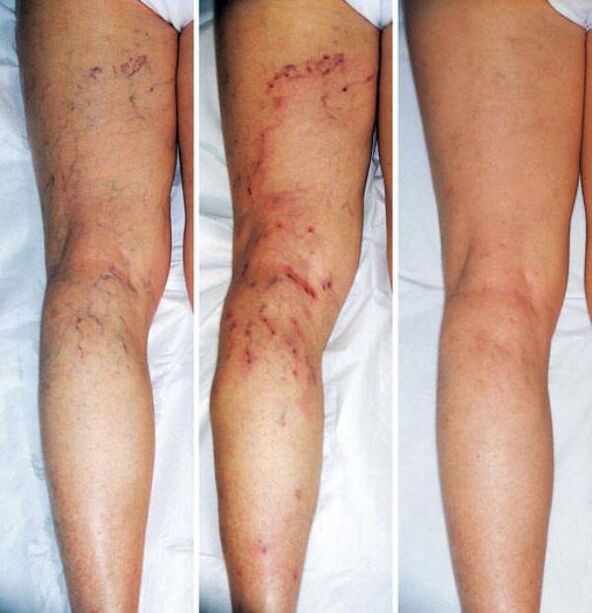
- Tortuous veins, cobwebs and spider veins appear on the skin.Sometimes in the evening there is a slight swelling of the legs.There is no pain or discomfort at this stage.
- Periodically, severe swelling of the ankle joint occurs, and heaviness in the legs also occurs (most often in the late afternoon and after exercise).At night, the patient suffers from cramps in the calf muscles, accompanied by goosebumps, numbness and tingling.
- Swelling of the legs becomes pronounced and becomes permanent.Seals are formed on the skin and subcutaneous tissue.Pigmentation and dermatitis also appear at this stage of the disease.In addition, the patient begins to suffer from itching and bloating.
- Trophic ulcers appear on the skin of the legs.
Varicose veins in themselves are not a dangerous disease, but in the absence of timely and effective treatment, they can lead to serious consequences, in some cases ending in death.
The most common complications caused by varicose veins:
- chronic venous insufficiency - difficult blood flow, which is a consequence of the poor functioning of the vascular valves due to an increase in the diameter of blood vessels;
- thrombophlebitis of varicose veins - formation of blood clots in the veins as a result of inflammation of the vein wall;
- pulmonary embolism - cessation of blood flow in the pulmonary artery due to its blockage by a detached blood clot;
- trophic ulcers are skin defects (wounds) that occur when there is a serious disruption of blood flow through superficial and deep veins.
Varicose veins always require qualified treatment.It does not go away by itself and gradually develops into various complications.Only you can reduce pain and discomfort.To prevent the disease and alleviate its symptoms, you must:
- avoid a sedentary (sitting or standing) lifestyle (move more often, change body position, do gymnastics, etc.);
- wear special medical knitwear;
- bathe only in the evening;
- sleep in a position where the feet are higher than the level of the heart (contraindicated for people with heart diseases);
- limit the consumption of salty food;
- wear shoes with a heel no higher than 4 cm;
- try not to sit with your legs crossed.
The diagnosis of varicose veins, in addition to a visual examination and palpation of the legs by a vascular surgeon, may also include additional examinations such as:
- Ultrasound is one of the most informative methods for diagnosing varicose veins of the lower extremities.It allows you to determine the degree of vein expansion, their patency, as well as determining the presence of blood clots and the direction of blood flow.
- Contrast venography is a method that allows you to see the contours of the affected veins on an X-ray.To do this, before the examination, a substance that dyes the blood in a contrasting color is injected into the vein.
Basic modern methods of treating varicose veins of the lower extremities
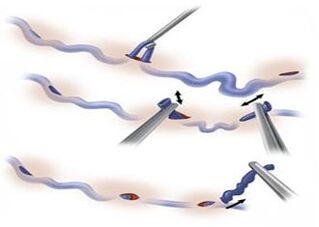
Miniphlebectomy
Miniphlebectomy is a gentle operation during which the affected veins are removed through small cuts and punctures using special hooks.It is often performed under local anesthesia, which allows the patient to return to his usual way of life within 2-3 hours after the procedure.In addition, thanks to minimal surgical intervention after miniphlebectomy, practically no traces remain on the skin of the legs, and all bruises and pigments finally disappear after a few months.
After this operation, it is necessary to regularly wear a special therapeutic knitwear for several weeks, and also strictly follow all the doctor's recommendations in order to prevent new relapses of the disease.
Radiofrequency ablation
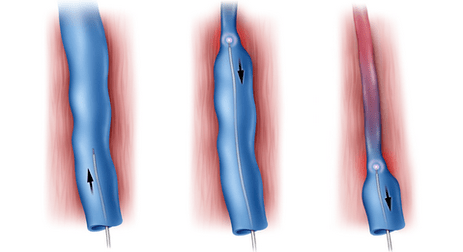
Radiofrequency ablation enables complete treatment of varicose veins on an outpatient basis.This procedure is carried out as follows: under local anesthesia, a radiofrequency catheter is inserted into the affected vein through a puncture, which "seals" the vein through exposure to a microwave oven.
Thanks to its precise and controlled effects, radiofrequency ablation enables effective results to be achieved.After this procedure, the patient returns to a normal lifestyle within 30 minutes, and active sports are allowed within a week.
Laser treatment (EVLT)
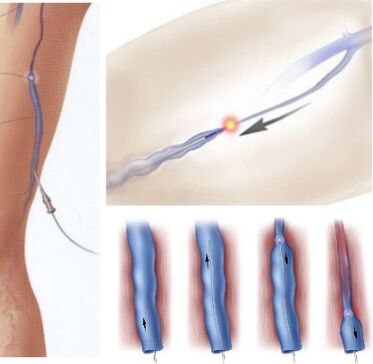
This method is also known for its minimal level of trauma and high cosmetic effect.This procedure is performed under local or spinal anesthesia.A light guide connected to a laser device is inserted into the lumen of the diseased vein through small punctures.Under the influence of laser radiation, the affected area of the vein is reliably closed (adjacent tissues are not damaged).The process of advancement of the light guide is controlled by the doctor using ultrasound, which ensures high precision of the procedure.
EVLT lasts about 30-40 minutes, after which the patient goes home independently and returns to his usual way of life the very next day.
Sclerotherapy
Sclerotherapy is one of the safest and most aesthetic methods of treating varicose veins (including "stars", "nets", "snakes"), which are completely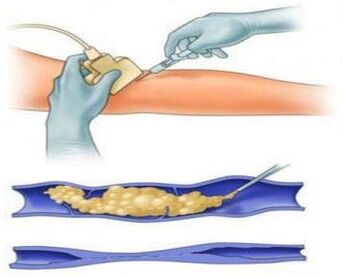 eliminates the appearance of scars and marks on the skin.The technique of this procedure is as follows: a glue solution (sclerosant) is injected into the affected vein with very thin needles, after which it is compressed from the outside with a special latex pad and an elastic bandage.Thanks to sclerotherapy, the walls of the blood vessels stick together, due to which the varicose vein is cut off from the blood stream, the circulation becomes healthy, and the symptoms of the disease disappear.
The procedure in question takes several sessions (about 3-5), each of which lasts from 5 to 10 minutes.After each procedure, the patient must wear a special sock, which is worn for 1 to 3 days.
It is important to note that in some cases different methods for the treatment of varicose veins are combined.
Treatment of trophic ulcers
Trophic ulcers often occur in the last stages of varicose veins as a result of venous stagnation.These are long-term non-healing affected areas of the skin and under it.
Treatment of this complication involves a comprehensive and multiphase approach.It may include surgical intervention and pharmacotherapy, wearing compression garments.In the initial stages, trophic ulcers are successfully treated with the laser method.In advanced cases, biopsy and radiopaque venography are used.
It is worth mentioning the importance of immediately contacting qualified specialists when the first symptoms of varicose veins of the lower extremities appear.In this way, you will eliminate the risk of complications and quickly regain your health.